Network Defined by Relationships(關係定義的網路) <<
Previous Next >> PCH10 Network Hardware(網路硬體)
Network Defined by Topology(結構定義的網路)
Besides geography and relationships, we can also define our networks by their topology. When we define our networks by their topology, we consider both the physical and logical topology, and both of these topologies do not have to match for a single network. The physical topology determines how the devices are physically connected, while the logical topology determines how the traffic flows across the network in a logical manner. There are many types of topologies, including bus, ring, star, full mesh, and hybrid. Currently, the most widely used model is a physical star and a logical bus topology using Ethernet.
除了地理和關係之外,我們還可以通過其拓撲定義網絡。當我們根據網絡的拓撲定義網絡時,我們會同時考慮
物理和邏輯拓撲,並且這兩種拓撲都不必針對單個網絡進行匹配。物理拓撲決定了設備的物理連接方式,而邏
輯拓撲決定了流量如何以邏輯方式流經網絡。拓撲類型很多,包括總線,環形,星形,全網格和混合拓撲。當
前,使用最廣泛的模型是使用以太網的物理星形和邏輯總線拓撲。
Bus Topology
Bus topology typically uses a single cable running through the area that needs network connectivity, with each device that wishes to connect to the network tapping into that cable. The devices tap into the cable using either a T connector (see diagram below) or a vampire tap. A vampire tap is actually a type of connection where a metal tooth bites into the cable, making a physical connection with the copper wire running inside the cable. While bus topology is an older technology and not commonly used anymore, physically, it can still be found as a logical implementation in some instances.
匯流排拓撲
總線拓撲通常使用一根電纜穿過需要網絡連接的區域,每個希望連接到網絡的設備都通過該電纜連接。設備使用T型連接器(請參見下圖)或吸血鬼抽頭插入電纜。吸血鬼抽頭實際上是一種連接,其中金屬齒咬入電纜,與電纜內部的銅線進行物理連接。儘管總線拓撲是一種較舊的技術,在物理上已不再使用,但在某些情況下仍可以將其作為邏輯實現。

Bus topology diagram. Image used under CC-BY-SA license from Nattydusadee.
總線拓撲圖。圖像由Nattydusadee根據CC-BY-SA許可使用。
Ring Topology
Ring topology typically uses a cable running in a circular loop, with each device connected to the ring. Data travels in a single direction around the ring. The most common use of ring topology is with backbone fiber networks. Fiber distributed data interface (FDDI) is a set of standards for transmitting data on fiber-optic lines in a LAN. FDDI commonly uses two counter-rotating rings to provide more redundancy. Each device waits its turn to communicate on the ring by passing a token around the ring. Therefore, ring topology networks are also called token ring networks. As there are two counter-rotating rings, FDDI tends to provide a little more redundancy than a standard bus topology. However, both bus and ring topologies were quickly replaced in most LANs by the star topology.
環狀拓撲
環形拓撲通常使用以環形迴路運行的電纜,每個設備都連接到環形。數據在環上沿單個方向傳播。環形拓撲最常見的用途是與骨幹光纖網絡一起使用。光纖分佈式數據接口(FDDI)是用於在LAN中的光纖線上傳輸數據的一組標準。 FDDI通常使用兩個反向旋轉的環來提供更多的冗餘。每個設備都通過在令牌環周圍傳遞令牌來等待其在令牌環上進行通信。因此,環形拓撲網絡也稱為令牌環網絡。由於有兩個反向旋轉的環,因此FDDI傾向於提供比標準總線拓撲更多的冗餘。但是,在大多數LAN中,總線和環形拓撲都很快被星形拓撲取代。

Ring topology diagram. Photo used under CC-BY-SA license from Marisa . pr.
環形拓撲圖。照片由Marisa . pr根據CC-BY-SA許可使用。
Star Topology
Star topology is by far the most common topology in use today. We find star topologies in use in nearly all local area networks. All the devices of the star topology connect to a single point. That single point of connection can be a hub or switch. In most modern networks, the single connection point will be a switch. Star topologies are the dominant physical topology today, although they are not always used as the logical topology. Ethernet cabling, also known as unshielded twisted-pair, is very commonly employed in local area networks using a star configuration. However, fiber-optic connections can also be used for high-speed or high-security networks. The downside with the star topology is that it creates a single point of failure. If a central device such as a switch fails, the entire network fails as well. Star topologies have the benefit of reduced expense and make expansion very easy, unlike bus and ring network varieties.
星型拓撲
星形拓撲是迄今為止使用的最常見的拓撲。我們發現幾乎所有局域網都使用星型拓撲。星型拓撲的所有設備都連接到一個點。單個連接點可以是集線器或交換機。在大多數現代網絡中,單個連接點將是一個交換機。星形拓撲是當今主要的物理拓撲,儘管它們並不總是用作邏輯拓撲。以太網電纜,也稱為非屏蔽雙絞線,在採用星形配置的局域網中非常普遍。但是,光纖連接也可以用於高速或高安全性網絡。星形拓撲的缺點是會造成單點故障。如果諸如交換機之類的中央設備發生故障,則整個網絡也會發生故障。與總線和環形網絡品種不同,星形拓撲結構具有減少費用並易於擴展的優勢。
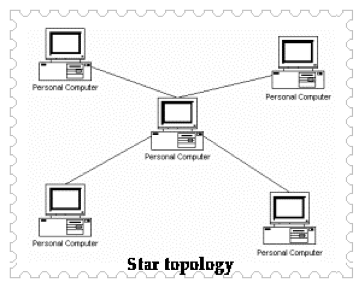
Star topology diagram. Photo used under CC-BY-SA license from Marisa. pr.
星形拓撲圖。照片由Marisa. pr根據CC-BY-SA許可使用。
Full Mesh Topology
To deal with the issue of redundancy, the full mesh topology was created. This topology is by far the most redundant, and expensive, topology because every node or workstation in the network is directly connected to every other node. While this provides optimal routing, it is very expensive to maintain and operate. The number of connections required for any number of nodes can be calculated by using the formula, x = n(n-1)/2. For example, if you have six nodes, that would require 15 cables to connect them all to each other. If you had 50 nodes, that would require 1225 separate connections. You can certainly see why this topology is almost never used for local area networks, as the number of machines would drive the number of connections up too quickly.
全網狀拓撲
為了解決冗餘問題,創建了全網狀拓撲。到目前為止,此拓撲是最冗餘,最昂貴的拓撲,因為網絡中的每個節點或工作站都直接連接到每個其他節點。儘管這提供了最佳的路由,但維護和操作非常昂貴。可以使用公式x = n(n-1)/ 2計算任意數量的節點所需的連接數。例如,如果您有六個節點,則需要15條電纜才能將它們彼此連接。如果您有50個節點,則需要1225個單獨的連接。您當然可以看到為什麼幾乎不將該拓撲用於局域網的原因,因為計算機數量過多會導致連接數量增加過快。

Photo used under CC-BY-SA license from Marisa. pr.
照片由Marisa. pr根據CC-BY-SA許可使用。
Partial Mesh Topology
To solve the cost issues created by the full mesh topology, engineers created the partial mesh topology. Partial mesh topology is really a hybrid full mesh topology. It provides redundancy and optimal routing between some sites, while avoiding the expense of connecting every single site. In order to create this successfully, though, you must consider the network traffic patterns to design it efficiently.
部分網格拓撲

為了解決由全網格拓撲創建的成本問題,工程師創建了部分網格拓撲。部分網狀拓撲實際上是混合全網狀拓撲。
它提供了某些站點之間的冗餘和最佳路由,同時避免了連接每個站點的開銷。但是,為了成功創建它,必須考慮
網絡流量模式以進行有效設計。
EXAMPLE
If we have two sites which are very busy, such as Los Angeles, CA and New York, NY, we may want to provide them with additional redundancy by connecting them to a third city, such as Washington, DC. But a slower site, maybe somewhere like Greenville, SC, might only need to be connected to one of those three sites and can then use that as a jumping off point to connect to the other two sites. This works very similar to our air travel system, where we connect the large cities together directly, and we avoid direct flights to small cities. For example, if someone wanted to fly from Greenville to Los Angeles they would first take a flight from Greenville to Washington DC, then a direct flight on a larger plane to Los Angeles from Washington.
範例
如果我們有兩個非常繁忙的站點,例如加利福尼亞州的洛杉磯和紐約州的紐約,我們可能希望通過將它們連接到第三個城市(例如華盛頓特區)為他們提供更多的冗餘。但是,速度較慢的站點(例如,南卡羅來納州格林維爾)可能僅需要連接到這三個站點之一,然後可以將該站點用作連接其他兩個站點的起點。這與我們的航空旅行系統非常相似,在航空旅行系統中,我們將大城市直接連接在一起,並且避免了直接飛往小城市的航班。例如,如果有人想從格林維爾飛往洛杉磯,他們會先從格林維爾飛往華盛頓特區,然後再乘較大的飛機直接從華盛頓飛往洛杉磯。
The same concept applies in a partial mesh topology. Partial mesh adds additional resources (connections) between the biggest and busiest sites, while still providing the smaller sites with minimal service to one of the large hub sites. The smaller site uses the large hub as a jumping off point to the rest of the network.
相同的概念適用於部分網格拓撲。部分網狀網絡在最大和最繁忙的站點之間增加了額外的資源(連接),同時仍然為大型樞紐站點之一提供較小的站點,但服務卻最少。較小的站點將大型集線器用作連接到網絡其餘部分的起點。

Mesh network topology diagram. Public domain image obtained from Wikimedia Commons.
網狀網絡拓撲圖。從Wikimedia Commons獲得的公共領域圖像。

Diagram of multiple classifications of network topologies. Public domain image obtained from Maksim.
網絡拓撲的多種分類圖。從Maksim獲得的公共領域圖像。
Network Defined by Relationships(關係定義的網路) <<
Previous Next >> PCH10 Network Hardware(網路硬體)